Cover / Journal / V-bombers
Valiant, Victor, Vulcan
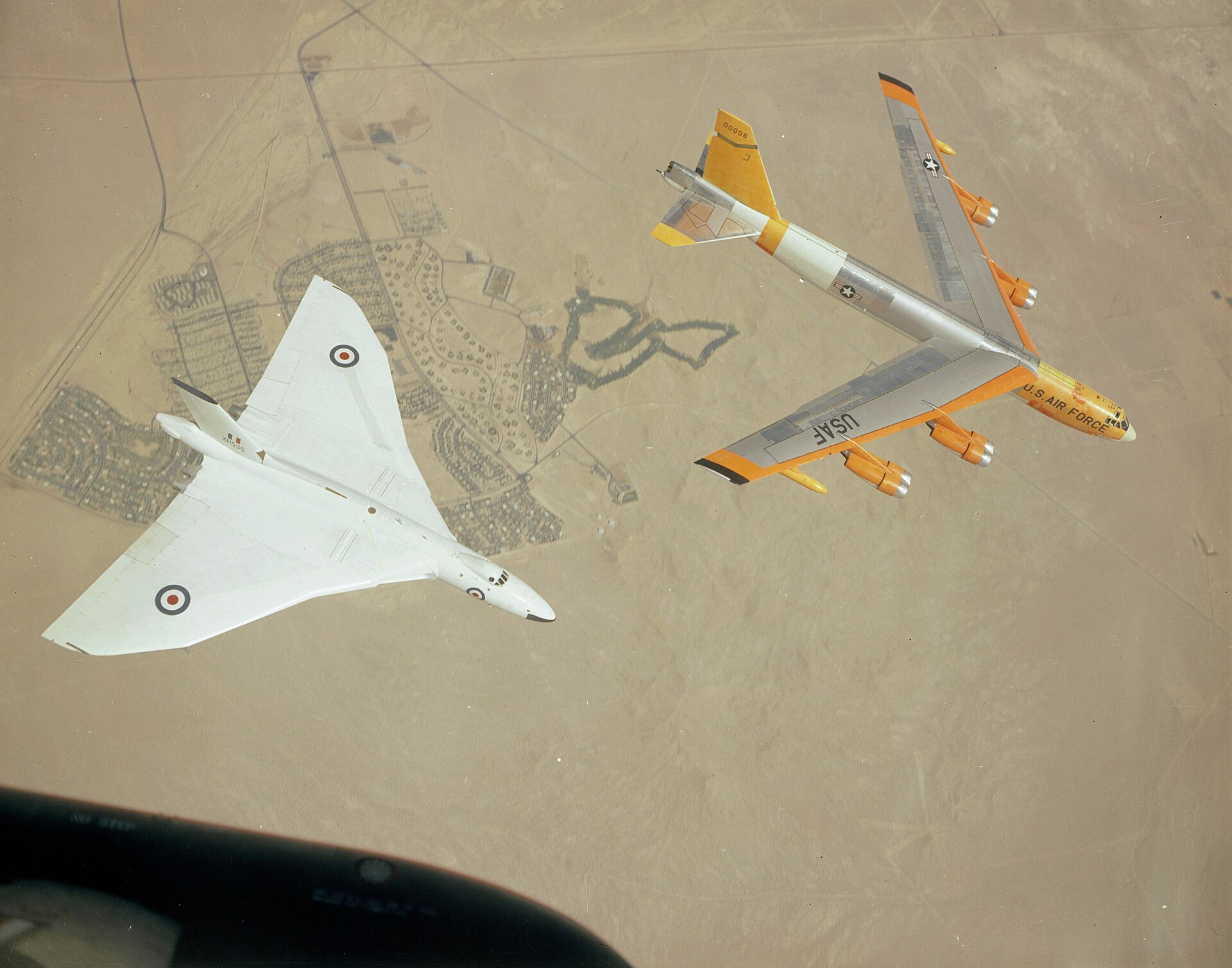
Britain built three V-bombers because it did not trust a single drawing in a nuclear decade, and because three firms had three plausible machines. They shared a political job. They did not share a wing, a career, or an afterlife. If you only remember the delta, you are remembering the one that outlived the other two in public. That is not the same as being the only one that mattered.
The paperwork started as two bets, not one. Specification B.35/46 asked for a high, fast jet bomber that could carry a British nuclear store a very long way. Avro and Handley Page both answered with something ambitious: a pure delta, and a crescent wing so complicated it still looks like a draughtsman's dare. Specification B.9/48 was the insurance policy — a more conventional four-jet that Vickers could get into service while the other two were still arguing with wind tunnels. That insurance policy became the Valiant. It arrived first. It did the dirty work. It then broke.
Valiant: the one that went first
The Vickers Valiant is the V-bomber people cannot pick out of a line-up. Shoulder wing, four engines, a tailplane that a schoolchild would draw. It entered Bomber Command in 1955, a year before the Vulcan and three before the Victor. In 1956 Valiants dropped conventional bombs on Egypt during Suez. In 1956–57 they dropped the live British nuclear weapons at Maralinga and, more famously, over Christmas Island during Operation Grapple. If you want the moment Britain became a thermonuclear power, you are looking at a Valiant, not a Vulcan.
The type also taught the RAF how to tank from a jet. That skill, later inherited by the Victor, is half the 1982 story. Then, in 1964, inspections found fatigue in the front spar. Low-level flying, which the force had been forced into by Soviet missiles, was exactly the regime the spar disliked. The bomber Valiants were grounded with a speed that still reads as a panic. A handful lingered in specialist roles; the fleet as a bomber ceased to exist. There was no display circuit, no charitable return to flight, no nickname that filled a souvenir stall. Brooklands keeps a cockpit. Cosford has a fuselage. That is the afterlife of the pathfinder: fragments, and a sentence in other people's captions.
We are not going to pretend this was unfair. Fatigue is not a morality play. It is metallurgy meeting a tactic the drawing office had not sold. The Valiant did what it was bought to do, including the jobs that let the prettier types look inevitable.
Victor: bomber, then the flying petrol station
Handley Page's Victor is the ornate one. The crescent wing was supposed to give high-Mach cruise without a delta's landing manners. The bomb bay was a cavern. Early Victors were as white as the rest of the V-Force; later ones wore camouflage and, after the Valiant died, a hose. As a bomber the B.2 could carry Blue Steel. As a reconnaissance machine the SR.2 did work the public never saw. As a tanker, the K.2 became the reason a Vulcan could appear over the South Atlantic at all.
That last career is the one enthusiasts still under-tell. Black Buck is sold as a Vulcan raid. It was a Victor operation that happened to finish with a bomber. Each successful night required a package of tankers refuelling each other so that enough fuel existed in the right piece of sky at the right minute. When a link in that chain broke, the bomber turned back. After the war the RAF even converted a few Vulcans into stopgap tankers because the Victor force had been wrung out — an undignified last act for the delta, and a compliment to the crescent wing it was copying.
Victors stayed in RAF service until 1993, longer than the Vulcan as a type in uniform. They did not stay in the imagination. A handful survive as museum pieces — Elvington, Cosford, Dunsfold's long argument — but no Victor ever became a national pet. Crowds do not make a noise that sounds like a crescent wing.
Vulcan: the one that stayed a bomber
Avro's Type 698 kept the bomber role longest. It took Blue Steel, then the low-level life, then a dense electronic fit in the tail, then a maritime radar job that was really a way of keeping crews current. In 1982 it dropped iron bombs on a runway, which is the only time a V-bomber went to war in the sense documentaries mean. A few finished as K.2 tankers with No. 50 Squadron until 1984. Then the force ended, and the afterlife began.
The silhouette is not a trivial advantage. A delta photographs as an idea. A Valiant photographs as an aeroplane. Fundraising, restoration, and the eight display seasons of XH558 all followed from that fact. People will write cheques for a shape they can still see on a mug. They will not write the same cheques for a conventional wing that did the first nuclear drops and then cracked. That is not a judgement on the crews. It is a judgement on us.
Technically the three types were answers to overlapping questions, not copies of each other. The Valiant was available. The Victor had range and a bay that became a fuel tank. The Vulcan had height, a howl, and a structure that, with enough inspection, tolerated the drop into the weeds. Polarising them into winner and losers is a pub game. The actual force was a three-legged stool. One leg broke in 1964. The other two spent the rest of the Cold War covering the gap, then covering each other with hoses.
What cameras actually did
Stand at Duxford or Cosford and count the children facing the delta. Then walk to a Victor, if the museum has one, and count again. Preservation follows affection, and affection follows a planform you can recognise at two miles. XH558 flew again; no Valiant did; the Victors that still exist do so as large, complicated static objects. We are not going to scold anyone for this. We are going to notice it, because otherwise the journal becomes another Vulcan fan site that treats 1952–1984 as a single-type story.
Where the other two went
If you want a Valiant, you are looking at pieces. Brooklands has the cockpit of XD816. Cosford has a fuselage section. That is not a slight on the museum: there is almost nothing left to hang a rope around. The type was scrapped with the haste of a force that had just discovered its first jet bomber was cracking. A Victor is easier. XL231 at Elvington still looks like a bomber that meant it. Cosford's XM715 and the long-running argument over XH672 at Dunsfold are the other names that come up in the car park. None of them howls. All of them are part of the same sentence as XH558, whether the souvenir stall agrees or not.
Blue Steel sat on Victors and Vulcans and not, in service, on the Valiant in the same way the posters imply. The stand-off round was a 1960s attempt to keep a high-level bomber out of the worst of a SAM belt. Low-level flying then made the missile's own life awkward. The Vulcan kept the bomber job after Polaris took the national strategic lead; the Victor kept the hoses. That division of labour is the real last act of the three-type idea. Not a flypast. A rota, and a tanker plan.
If you want the delta as a machine, start with the airframe and why it has no tailplane. If you want the years when all three were supposed to sit on QRA together, read Sitting QRA. The comparison is not a ranking. It is a reminder that Britain's airborne deterrent was a committee, and committees leave uneven ruins.